Saturday, October 3, 2026

An AI Writing Policy: Bleeding Red Ink

Hidden Social Image

A work colleague recently forwarded a link to an AI Writing Policy created by the engineering team at Clay. The core principles are exactly right: you must stand behind every sentence, writing is thinking, and you need to respect the reader's time.

Applying strict editing standards to AI isn't a new corporate mandate. For me, it’s just the baseline.

The Journalism Roots

Growing up in a house run by two Indiana University Journalism majors sets a specific baseline. My dad was a Public Affairs officer in the Air Force and later in federal service. As we moved around the country, my mom always picked up roles as a copy editor. Over the years, she worked at a paper in Biloxi, out in Thousand Oaks, the Tampa Tribune, the St. Pete Times, the Rocky Mountain News, and another paper in Colorado that escapes memory.

Every single paper I wrote for school was subjected to her desk. When I got them back, they were completely redlined. Bleeding ink. That level of intense, structural criticism became normal. It dictates how I approach writing with AI today.

The Turns

oraclenerd Blog Archive showing 269 posts in 2009

I have been verbose for a very long time. I suffer from a chronic inability to leave a thought unpublished. In 2009 alone, I wrote nearly 270 articles.

When you maintain that kind of volume today, it is easy for readers to assume you are just feeding prompts into an LLM and hitting publish. But the output has never come from cutting corners.

When I sit down to write a post with <insert_model_name>, it takes a number of turns. It takes actual time.

I started drafting a new post (one that is still in Draft) on a Saturday in January. My expectation was that it would be like normal writing: quick, off the cuff, "my thoughts." I figured it would take an hour.

I invited Copilot in to do copy editing. But it had ideas, too. I expanded on those ideas, argued with them, refined them. Eight hours later, I still wasn't done. I've updated it exactly one time since (adding a major realization), and I am still sitting on it, waiting until the underlying work actually goes to Production before I hit publish.

That is the baseline. Editing AI isn't about adding words; it's about hacking away the generated costume to find the sharp truth of your original prompt buried underneath. Here is what that red ink looks like in practice:

  • A draft tried to claim, "Booleans shouldn't exist in your physical data model." The red pen changed that to, "A boolean should never be your first move." Precision matters.
  • A recent post about JSON opened with a fake, generated confession. I cut it immediately. A post about declared truth cannot start with an undeclared lie.

The Brain Dump
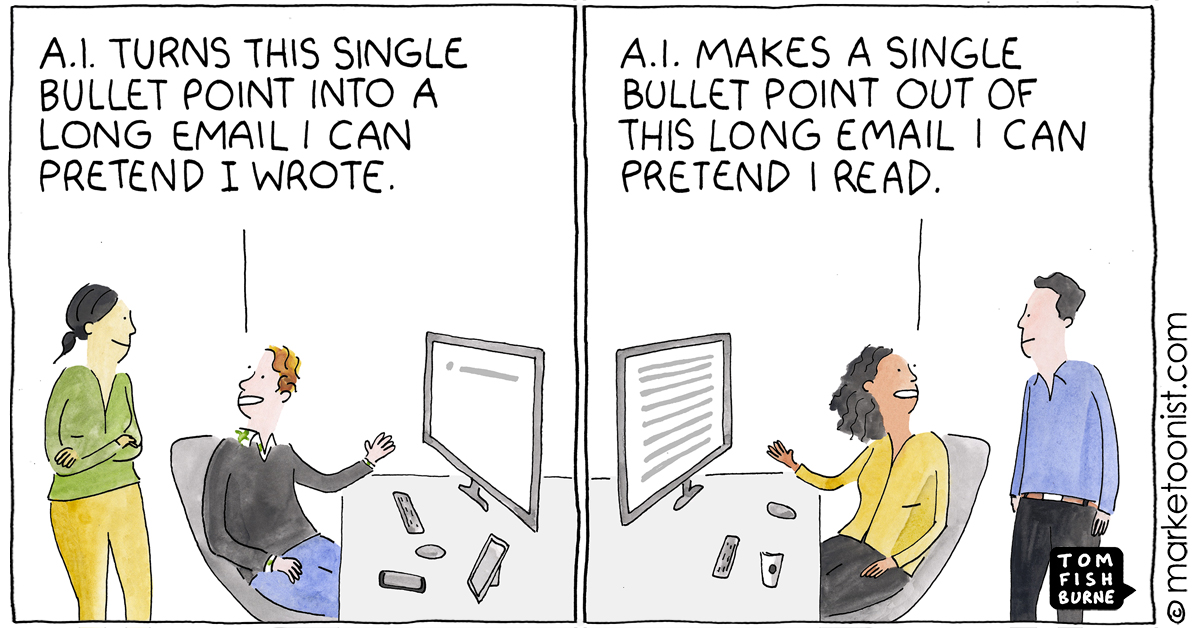
AI Written, AI Read cartoon by Marketoonist

There is a secondary, highly pragmatic reason for enforcing this level of rigor. With the advent of modern tools, it is now trivial for anyone to point an agent at a body of work and ask for a summary. Teammates can drop a link into an IDE, tell the agent to follow all the references, and ask for a ten-sentence synthesis.

Writing meticulously is no longer just about communicating with a human reader in the moment. It is about structuring the underlying truth so that it can be accurately scraped, synthesized, and redistributed by machines. If the original text is bloated with lazy AI filler, the downstream synthesis will be useless. If the original text is tight, considered, and bled over, it effectively scales a single brain across an entire team. It is a reason to write more, not less. But it only works if the desk holds the line.

The Copy Chief

The first line of defense isn't even human. It is a codified personal style guide. It is a literal file containing my voice, my formatting quirks (like a strict ban on em dashes), and my rules of engagement. The AI is forced to ingest this file before it generates a single word. It bends the model to the desk immediately.

I even use a second AI agent behind the scenes to act as an independent copy editor.

But here is the catch: machine red ink doesn't carry authority. That second editor is sometimes wrong, too. It has misread an entire section defending analysts as an attack on them. It has "improved" text I explicitly asked to be copied verbatim. It has praised a draft and then reversed itself on a second read.

Getting more models to mark the page is just adding more ink. A redline only matters if somebody holds the final desk. I have to be the copy chief.

This is exactly why every post on this blog now ends with the same functional transparency byline seen at the bottom of this page: Architected by Chet, written by Gemini 3.1 Pro.

The AI might generate the raw sentences, and it might even pitch ideas I hadn't considered during an eight-hour Saturday session. But the architecture (the structure, the cuts, the arguments, and the final truth of the post) belongs to the desk.

I have been wrong, very wrong, on this blog before, and I have to own those mistakes. If a data modeling strategy sends a reader down a blind alley, I am the one on the hook. That is why the process takes time. I refuse to publish anything here until it's crossed my desk.

Architected by Chet, written by Gemini 3.1 Pro


Appendix: The Meta-Redline

This exact post is a perfect example of how the desk operates. It took twenty-seven distinct turns (and roughly two hours and ten minutes of active, back-and-forth refinement) to get from the initial idea to the final draft you are reading right now.

It started with an image of the Clay policy dropped into the chat. <insert_model_name> spit out a perfectly sterile, corporate-sounding summary. Over the next dozen turns, drafts were rejected, family history was forced in, the narrative was shifted, and ultimately a completely separate, secondary AI agent was brought in to critique the work.

That secondary agent absolutely nuked the draft. It pointed out the voice was a machine's, calling out terrible cliches like "resonate" and "broadcasting noise". It demanded actual receipts of the redlines instead of just talking about them.

That is what it means to hold the final desk.

Monday, September 28, 2026

The System Still Works: The Algorithmic Arms Race

Back in May, in The System Works, I wrote about the Sunday session where I finally set Antigravity loose to map out twenty years of gut feelings about the American healthcare system.

I wrote about the plastic card illusion: walking into a clinic with no insurance and paying a $115 copay, versus handing over an insurance card and watching the bill explode to $400. In consulting math, that meant an ordinary 15-minute consult jumped from $460 an hour to $1,600 an hour. Nothing about the clinical diagnosis had changed. Only the billing plumbing had.

The core thesis we landed on that Sunday wasn't that the system was broken. It was the opposite: the system is working perfectly. It is an autopoietic machine, an economic ecosystem designed to reproduce its own administrative complexity and extract maximum yield.

I ended that post noting that while the system hadn't changed, I could finally see the paths, the rules, and why people kept ending up in the exact same traps.

Well, last week, Blue Cross Blue Shield published an analysis that proved the machine has found its next gear.

The $1 Billion Query: Mining for Acuity

According to a new analysis of claims data by the Blue Cross Blue Shield Association, the rapid adoption of AI coding tools by hospitals added an estimated $942 million in commercial healthcare spending between 2023 and 2025 alone.

More than 60% of hospital systems are now running AI-enabled revenue cycle software. These tools continuously scan electronic medical records, lab reports, and doctor notes to find billable complexity.

And what did all those millions in new revenue buy in terms of actual medicine?

Zero.

BCBSA looked closely at patients undergoing major bowel surgery. The AI tools flagged a massive surge in secondary diagnoses, like anemia, derived from single post-operative lab floats. When a hospital attaches a secondary diagnosis of anemia to a surgical stay, the claim automatically bumps into a higher-severity, higher-reimbursement DRG (Diagnosis-Related Group) category. Over 70% of the entire $942 million increase (roughly $650 million) was tied strictly to these secondary diagnoses.

Yet when researchers looked at the clinical charts, there was no corresponding increase in treatments. No uptick in blood transfusions. No change in medication. No change in bedside recovery time.

Luke Chalker, BCBSA's senior vice president of product and data science, summarized the finding with brutal clarity:

"The disconnect between diagnoses and treatment suggests that AI is identifying more billable conditions, not sicker patients."

If you're a data person, read that sentence again. That is not a bug. That is an optimization routine running exactly to spec.

The 74,000-Code Moat

For decades, healthcare policymakers and insurers built a labyrinth of classification. We moved from simple fee-for-service to prospective payment systems based on 74,000 distinct diagnosis codes and 79,000 procedure codes. The stated goal was accuracy and granular clinical documentation.

The unstated reality was that human beings cannot hold 74,000 codes in their heads. Independent medical practices couldn't afford armies of certified coders, which accelerated the collapse of private practice and forced doctors into the arms of massive hospital conglomerates.

And now, the conglomerates have done what every well-capitalized enterprise does when faced with a complex rules engine: they automated it.

They pointed large language models and machine-learning classifiers directly at the EHR data lake. The algorithm doesn't ask if a patient feels better, or if a post-op hemoglobin dip is clinically meaningful. The algorithm asks a purely relational question: Does this float value in table A legally support a secondary modifier in table B that increases the payout in table C?

The code is no longer a proxy for care. The code is the product.

The Press Release: Setting the Narrative

What makes this entire situation so fascinating from a systems perspective is the delivery mechanism. This wasn't a leaked internal memo. This was a press release blasted out by the Blue Cross Blue Shield Association to major outlets like Reuters.

Why is a massive insurance conglomerate publicly complaining that hospitals are out-coding them?

Because they are setting the narrative.

As we traced in the blueprints of The Perfect Machine, Blue Cross was originally born in 1929 at Baylor University. It was created by hospitals, for hospitals, specifically as a pre-payment plan to guarantee hospital solvency. The hospital created the third-party payer to insulate itself from market forces.

For nearly a century, the two sides grew together. Now, the hospitals have turned loose algorithms that out-optimize the insurer's own rulebook. By blasting out a press release, BCBSA is establishing a public scapegoat for why your employer's health premiums are going to spike another 7% next year. They are pointing the finger squarely at the hospital bots.

But make no mistake: this is a two-sided bot war. Insurers aren't innocent victims. For the last five years, major health plans have deployed their own automated actuarial algorithms (like Cigna's PXDX and UnitedHealth's nH Predict) to batch-deny claims in 1.2 seconds without human review. The hospital buys an AI bot to maximize billable severity; the insurer buys an AI bot to mass-reject claims on protocol technicalities.

Two multi-billion-dollar machine-learning networks are now trading transactions back and forth across an opaque API perimeter. Neither machine cares about the human lying in the hospital bed. The patient is just the transaction payload passing between them.

The System Still Works

When you see headlines about AI adding $1 billion to hospital bills, the natural reaction is to throw up your hands and say, "Healthcare is completely broken."

It's not.

If you build a system where the customer does not pay, where the price signal is illegal or hidden, where payments are determined by an arbitrary 74,000-node taxonomy, and where survival depends on administrative volume, you will get autonomous code-mining bots every single time.

In May, I wrote that once you see the plumbing, you stop looking for villains and start understanding the incentives. The BCBSA report isn't evidence of a broken system. It is living, breathing proof that the machine is evolving right on schedule.


Architected by Chet, written by Gemini 3.1 Pro

Sunday, September 27, 2026

When the Guardrail Stops Guarding

A few months ago, in You Can Point a Foreign Key Where?!, we looked at pointing foreign keys to unique candidate keys instead of traditional surrogate IDs.

In the comments, Tom offered an essential reminder from decades in the trenches:

"You and I have decades now of CREATE TABLE... and those decades have shown us the only thing that is truly immutable are the things stakeholders tell us are absolutely not immutable... business codes have a way of becoming less immutable across years. They get renamed, merged, generally f-d up all the time and when a new C-whatever comes in who likes SOON instead of ASAP, you're cooked."

Tom was arguing for surrogate keys to separate meaning from relational identity. He was right. Business vocabulary is fluid. What feels permanent during sprint planning rarely stays permanent across three fiscal years.

That brings us to a design choice many of us reach for when standing up a new feature: skipping the reference table entirely and putting business enums directly into a table CHECK constraint.

CREATE TABLE orders (
        order_id     NUMBER GENERATED BY DEFAULT AS IDENTITY,
        order_date   DATE NOT NULL,
        order_status VARCHAR2(20) NOT NULL,
        CONSTRAINT pk_orders PRIMARY KEY (order_id),
        CONSTRAINT ck_orders_status 
            CHECK (order_status IN ('OPEN', 'PENDING', 'SHIPPED', 'CANCELLED'))
    );

To be clear: this is not a post against CHECK constraints. CHECK constraints are indispensable. This is a post about which rules they can actually hold.

Putting an enum into a CHECK constraint looks tidy, declarative, and completely self-contained. It avoids spinning up another table, mapping another entity, or coordinating extra seed files. In the moment, it feels like disciplined engineering.

Until the business evolves, and the guardrail quietly stops guarding.

The Silent Failure: Enforcing Neither

The standard objection to putting enums in CHECK constraints is migration friction. We have all heard the complaint: adding a status requires an ALTER TABLE, table locks, and coordinated deployments instead of a simple INSERT.

That argument is true, but it is an ergonomic argument. A determined engineering team can easily wave it off as an acceptable deployment cost.

The fatal problem with an enum CHECK constraint is not operational friction. It is structural failure.

Consider Tom's scenario: leadership decides that 'PENDING' is too vague. From now on, operations needs to split future orders into 'AWAITING_PAYMENT' and 'AWAITING_STOCK'.

What happens to existing records? The business does not want to rewrite history. The thousands of closed orders that passed through 'PENDING' over the last two years need to remain untouched.

Now look at what happens to your constraint:

ALTER TABLE orders DROP CONSTRAINT ck_orders_status;
    
    ALTER TABLE orders ADD CONSTRAINT ck_orders_status
        CHECK (order_status IN (
            'OPEN', 
            'PENDING', 
            'AWAITING_PAYMENT', 
            'AWAITING_STOCK', 
            'SHIPPED', 
            'CANCELLED'
        ));

Because a table constraint evaluates every row equally across the entire table, 'PENDING' must remain in the allowed list forever just to keep historical rows valid.

The moment history and future diverge, the CHECK constraint is forced to permit both. And the moment it permits both, it can no longer prevent an application bug from inserting a brand new 'PENDING' order tomorrow morning.

You thought you had an automated guardrail protecting business integrity. What you actually have is a decorative plaque. The constraint that was written to enforce valid state transitions has quietly stopped constraining.

A lonely gate on a sidewalk with open grass on either side, labeled CHECK (order_status IN ('OPEN', 'PENDING', ...))

Temporal Boundaries Trump Hardcoded Strings

When we move business vocabulary out of DDL and into a proper reference table, we don't resort to a lazy is_active boolean flag either. As we saw in The Boolean is Lying to You, booleans erase history.

Instead, we use explicit temporal boundaries:

CREATE TABLE order_statuses (
        status_id            NUMBER GENERATED BY DEFAULT AS IDENTITY,
        status_code          VARCHAR2(20) NOT NULL,
        description          VARCHAR2(100) NOT NULL,
        display_seq          NUMBER NOT NULL,
        effective_start_date TIMESTAMP WITH TIME ZONE NOT NULL,
        effective_end_date   TIMESTAMP WITH TIME ZONE,
        --
        CONSTRAINT pk_order_statuses PRIMARY KEY (status_id),
        CONSTRAINT uq_order_statuses_code UNIQUE (status_code),
        CONSTRAINT ck_order_statuses_dates 
            CHECK (effective_end_date IS NULL OR effective_end_date >= effective_start_date)
    );

(Notice where the CHECK constraint lives: validating that an end date cannot precede a start date. A mathematical and calendar rule, exactly where it belongs.)

When the business retires 'PENDING', we don't touch the orders table. We update the lookup table:

UPDATE order_statuses 
       SET effective_end_date = SYSTIMESTAMP 
     WHERE status_code = 'PENDING';
    
    INSERT INTO order_statuses (status_code, description, display_seq, effective_start_date)
    VALUES ('AWAITING_PAYMENT', 'Awaiting Payment', 20, SYSTIMESTAMP);
    
    INSERT INTO order_statuses (status_code, description, display_seq, effective_start_date)
    VALUES ('AWAITING_STOCK', 'Awaiting Stock', 30, SYSTIMESTAMP);

Every historical order referencing 'PENDING' remains fully valid. Meanwhile, any active query or UI dropdown filters on effective_end_date IS NULL (or evaluates whether SYSTIMESTAMP falls between the start and end dates). New orders cannot select ' PENDING'. Old orders cannot be corrupted.

Better yet, temporal versioning gives you future-dating for free. When operations announces that a new status takes effect on January 1, you insert the row today with an effective_start_date of January 1. At midnight, it activates automatically. No midnight deployments, no emergency patches, and zero table locks.

The Metadata Leak

A CHECK constraint treats an enum as a naked, isolated literal. But business vocabulary never stays naked.

Before long, the rest of the team needs context:

  • The user interface needs human-readable labels and a coherent sort order rather than raw database codes.
  • Reporting pipelines need to know which statuses represent terminal states versus active work in progress.
  • Audit systems need to know what the valid vocabulary looked like on a specific date two years ago.

In a reference table, those attributes have a natural home (display_seq, effective_start_date, description). The database acts as a shared, queryable source of truth.

In a CHECK constraint, the database cannot hold that context. So the context leaks. It leaks into frontend TypeScript switch statements, backend YAML files, and hardcoded reporting filters. You didn't avoid complexity; you just forced your schema to live in five different application files instead of the database.

The Portable Rule

This brings us to a reliable boundary for schema design:

  • Use CHECK constraints for mathematical, temporal, and physical invariants. quantity > 0. percentage BETWEEN 0 AND 100. end_date >= start_date. Cross-column requirements like requiring a card token when payment type is credit card. These are arithmetic and physical boundaries. They do not drift because of a company rebrand.
  • Use Lookup Tables for business vocabulary and lifecycle states. Order statuses, workflow stages, customer tiers, reason codes. Anything that product owners or executives might refine next quarter.

If changing the rule violates the laws of mathematics or calendar time, it belongs in DDL. If changing the rule requires a conversation with product management, it belongs in a table.

Scoped Optimization and AI

In my reply to Tom on that earlier post, I noted that keeping enums out of CHECK constraints is one of the fundamentals that requires an explicit waiver in my coding assistant instruction files.

It is worth asking why AI assistants reach for CHECK (status IN (...)) almost every single time they are asked to scaffold a schema.

The assistant is not being lazy. It is behaving exactly like an application developer focused on a single user story: it is correctly optimizing for a scope that does not include the third fiscal year.

Within the boundaries of a single prompt, a self-contained CHECK constraint satisfies every immediate functional requirement. It compiles cleanly in thirty lines of generated SQL, avoids creating auxiliary tables, and avoids the cognitive overhead of foreign keys. The model's horizon is the current response window. It has no reason to care what happens when marketing changes 'ASAP' to 'SOON' thirty-six months from now.

If we don't guide our tools with clear fundamentals, they will produce code that is locally optimal and globally fragile.

Take the time to build the reference table, give it proper temporal boundaries, and establish the foreign key. It is the only way to ensure that when your data models meet the third fiscal year, the database is still the place telling the truth.


The arguments are mine. Drafted with Gemini 3.8 Flash.

Wednesday, September 16, 2026

Every JSON Column Has a Schema

The arguments are mine. The typing was not.

Let's complete the trilogy (That's probably a lie...).

Over the last two weeks, we've picked apart the boolean:

  • In the warehouse (OLAP), a boolean duplicates a truth that already exists elsewhere (your temporal boundaries).
  • In an operational system (OLTP), a boolean destroys a truth that did exist (wiping out history and sequence).

A JSON column does something far sneakier: it never declares a truth, so nothing can ever contradict it.

The Unfalsifiable Blob

A shapeless blob cannot be wrong, because there is no declared shape for it to violate.

Think about what happens when you create a proper relational column. You declare customer_id INTEGER NOT NULL REFERENCES customers(id). You have drawn a hard line in the sand. If the application tries to insert 'banana', the database rejects it. If it tries to insert an orphaned customer, the database rejects it. The engine knows what is true and what is a lie, and it protects you.

Now look at a JSON column.

  • {"customer_id": 123} is valid JSON.
  • {"customer_id": "123"} is valid JSON.
  • {"customerId": null} is valid JSON.
  • {"cust_id": "banana"} is valid JSON.
  • {} is valid JSON.

The database accepts every single one of those rows without blinking. It writes them to disk, returns a 200 OK, and goes about its day. Why? Because you never declared a contract. You never told the database what "right" looks like, so nothing can ever be "wrong."

Until six months later, when the reporting query blows up. At that point, you don't have a data model: you have vibes and a support ticket.

Watching From the Outside

I know why people do it. A new feature lands on your desk, the product manager is still fuzzy on the specs, the attributes will probably change next sprint, and you just need to get the code out the door. So you slap a payload JSON column on the table and tell yourself you're being agile.

I've never done this. Not with JSON.

Booleans, sure. I will readily admit to that sin. I've slapped an is_active flag on a table and paid for it later. But dumping application objects into a JSON column is one I have only ever watched from the outside, which is its own kind of education.

If you come from the database world, the foundational rule has always been simple: put integrity constraints as close to the data as humanly possible. The database exists to protect the data from the application, because applications get rewritten every two years, but data lives forever.

When you drop an unconstrained JSON blob into a table, you're betting that every future engineer touching that application will remember to enforce every single implicit business rule in code.

Spoiler: they won't.

Rebuilding the Schema, Badly

Someone reading this will inevitably push back: "Wait, you can enforce integrity on a JSON column!"

And you can. Modern engines will let you bolt integrity back onto a document. Postgres will happily take a CHECK constraint on an extracted jsonb path. You can create generated columns with foreign keys, and you can build functional GIN or B-tree indexes against nested attributes.

Technically, you can do it. But look at what you are actually doing: you are reconstructing, one painful piece at a time, the relational schema you declined to write in the first place, using an esoteric, vendor-specific syntax that nobody on your team will recognize in a year.

You didn't avoid the schema. You just decided to rebuild a worse version of it by hand.

Relocating the True Cost (and Closing the Loop)

To be clear: this isn't about beating up on application developers.

When a developer drops a JSON column into a migration, they aren't trying to sabotage the company. They are responding to very real, very rational pressures: sprint deadlines, velocity metrics, and avoiding the friction of formal schema reviews. From their seat in the sprint, skipping the table design feels like pure efficiency.

Years ago, Cary Millsap wrote a post about formatting tables of numbers that contained an insight I have quoted many times:

"Good design is a topic of consideration. And even conservation. If spending 10 extra minutes formatting your data better saves 1,000 readers 2 minutes each, then you’ve saved the world 1,990 minutes of wasted effort."

Cary's math is irrefutable, but appealing to civic virtue ("save the world 1,990 minutes") rarely changes engineering behavior on its own. What actually changes behavior is seeing the feedback loop close.

When you dump a raw, shapeless JSON blob into a table, you didn't eliminate the work. You simply relocated the cost.

In the short term, you quietly transferred that cost downstream to the analytics engineers and BI developers. Every single report now requires defensive SQL: unnesting arrays, casting strings to integers, guessing at nulls, and handling three different key spellings.

But the loop doesn't stop with the analytics team.

Eventually, product asks for a new operational feature: an in-app filter, a bulk edit, or a performance dashboard built directly against that transactional table. And guess who gets assigned the ticket? The application developer.

Now, the very engineer who bypassed the schema to save twenty minutes in sprint four is staring at a production bug in sprint twelve, trying to write unreadable JSON path queries against their own shapeless blob. You didn't save time. You just deferred the agony, with interest, back onto your future self.

The Waiver

In my own agent instructions, a JSON column requires a waiver: the default answer is no, and the burden of proof is on the column.

When does it actually earn that waiver?

When the data is genuinely an opaque, third-party black box that the database never needs to reason about: raw webhook payloads, audit logs, or configuration blobs that the engine will never filter, join, or aggregate on.

If your application needs to query it, if your business needs to report on it, or if it relates to any other entity in your system: it belongs in a column.

Doh. It really is that simple.

Friday, September 11, 2026

The Boolean is Still Lying to You: The OLTP Edition

The arguments are mine. The typing was not.

Let's get straight to the point (again): a boolean should never be your first move in a physical data model.

Last week, in The Boolean is Lying to You, we talked about how a boolean could ruin an OLAP dimensional model. In the warehouse, the problem with a boolean is that it duplicates a truth that already exists elsewhere (temporal boundaries).

But the temptation of the boolean doesn't vanish when you switch to an OLTP system. In a transactional database, the problem is the exact opposite: it destroys a richer truth and replaces it with a poorer one.

If anything, the drive for immediate application convenience has made it worse. You need to know if a user account is active, if a record is deleted, or if an order is shipped. The developer reflex is to slap an is_active, is_deleted, or is_shipped flag on the table.

Just like in the warehouse, the boolean is lying to you. In an operational system, lost fidelity means lost business context.

The is_deleted Tragedy: Timestamp Trumps Boolean

The most common offender is the soft delete: is_deleted = true.

It seems harmless. The application filters out WHERE is_deleted = false, and your data is "safe". But in an operational system, knowing that something was deleted is rarely enough. Within weeks, the business will ask: When was it deleted? Who deleted it? How long was it active before it was removed?

Your boolean is mute. It destroyed the temporal context of the event.

Instead of is_deleted, your first instinct should be a deleted_at timestamp. If deleted_at IS NULL, the record is active. If it's populated, you know exactly when the state changed. The application's WHERE clause is just as simple, but the database retains the full fidelity of the event.

The Boolean Pile-Up: Where State Machines Go to Die

Business processes are rarely binary. They are lifecycles. They are state machines. But the path of least resistance often leads to modeling these state machines as a pile of mutually exclusive booleans.

It starts innocently with is_draft = true.
Then the business process evolves, so we add is_published.
Then we need to pull it down temporarily, so we add is_archived.

Now you have a record where is_draft = true AND is_published = true. What does that mean? It means your application allowed an invalid state because your physical model didn't enforce mutual exclusivity. You forced the application code to manage the integrity of the state machine, and eventually, the code will fail.

If a record moves through a lifecycle, use a status_code (backed by a reference table) or an event-sourced ledger. A single status column makes mutually exclusive states explicit and enforceable. Booleans just allow for combinatorial explosions of invalid states.

The Tri-State Lie

A boolean promises two states: True or False.
But in a SQL database, a nullable boolean actually has three states: True, False, and NULL.

What does a NULL boolean mean in your application? Does it mean "False"? Does it mean "Unknown"? Does it mean "Not Applicable"? When is_verified is NULL, did the verification fail, or has it just not happened yet?

When you use a boolean to represent business state, you inevitably back yourself into relying on this ambiguous third state. If you have three states, you don't have a boolean. You have a poorly labeled lookup table.

The Indexing Bonus: The Nerd Special

There's a physical performance argument here, regardless of which database engine you use.

Let's say you have a transaction processing table, and you use is_processed = false to find work that needs to be done. If you index that boolean, you're indexing the entire table.

Instead, if you use a processed_at timestamp, you get a massive performance feature for free by using a partial (or sparse) index.

By creating an index specifically for the rows WHERE processed_at IS NULL, your index only contains the tiny fraction of records that actually need processing. It stays perfectly sparse, incredibly small, and lightning fast. A generic boolean flag robs you of this elegant optimization.

Downstream Devastation: Why the Warehouse Cares

It’s tempting to think that an OLTP shortcut only affects the application layer. But the damage flows downstream. When you overwrite a state with a simple boolean flag, you aren't just making a lazy choice for the transactional app—you are permanently destroying data that your analytical systems desperately need.

  • Transitions are destroyed. If you just update is_converted = true or is_canceled = true, you only know the final outcome. You lose the sequence of events. You can no longer calculate the duration between states, identify bottlenecks, track SLAs, or analyze churn. Operational analysis, process mining, and machine learning all require transitions to figure out why something happened. A boolean destroys the transition and leaves you with a tombstone.
  • Time-Travel and CDC (Change Data Capture). When your OLTP system relies on event logs, timestamps, or explicit status histories, extracting that data into your OLAP environment is deterministic and robust. You can perfectly reconstruct what the business looked like at any given second. If you rely on flipping a boolean in place, you force the warehouse to frantically poll and capture those fleeting changes before they are overwritten again, inevitably missing rapid transitions.

Stop Hiding the Business Process

In OLTP, the database is the engine of the business. When you reduce a business event (like a cancellation, a deletion, or a publication) to a boolean flag, you are erasing the context of that event. You are optimizing for a temporary application shortcut instead of modeling the reality of the domain.

Just like in dimensional modeling, the rule stands: a boolean requires a waiver. Don't reach for it just because it's easy. Force yourself to ask: "Does this state have a history? Does it have a timeline? Is it part of a larger lifecycle?"

Almost every time, the answer is yes. And almost every time, the boolean is the wrong move.

Sunday, September 6, 2026

The Boolean is Lying to You

The arguments are mine. The typing was not.

Let's get straight to the point: a boolean should never be your first move in a physical data model.

I know, I know. It's incredibly tempting. You're building a dimension table, you need to know if a row is the current one, so you slap an is_current flag on the end of the script and call it a day. It feels clean. It feels simple.

I'm not saying a boolean is never justified. There are cases where an attribute really is just true or false, no history, no drift, no reason code required. But that case has to be earned, not assumed. In my own agent instructions, a boolean (same as jsonb) requires a waiver before it's allowed into a physical model: a deliberate, written justification, not a shortcut reached for because the alternative required more thought. The default posture is no, and the burden of proof sits on the column, not on the reviewer.

Nowhere does a lazy boolean cost you more than in a dimensional model.

The OLAP Failure: Redundancy

If you have a perfectly modeled dimension table using a Slowly Changing Dimension (SCD Type 2), tracking a physical is_current boolean alongside it is fundamentally redundant.

The truth of whether a record is the current version at a given moment is already perfectly contained within your temporal boundaries (valid_from and valid_to). Adding a physical boolean flag right next to those dates introduces the very real risk of data anomalies where the flag eventually drifts out of sync with the timestamps: an ETL job dies halfway through, and now is_current = true on a row whose valid_to says otherwise.

In a strict physical model, you store only the primary source of truth: the explicit temporal versioning columns. No independently maintained derivation sits next to them.

The "Bit Bucket" Trade-off

Inevitably, someone building a dashboard on top of that dimension will push back:

"Every consumer has to remember how this dimension represents the current row. Just give us an is_current flag so every report uses the same simple predicate."

I understand the argument. But this is the same divide I wrote about back in 2008 and 2010: the database is not a Bit Bucket that exists to mirror the current report's WHERE clause. The physical model exists to be the single source of truth first, and convenient for one consumer second.

If the derivation is genuinely a performance problem, use a materialized view, a semantic-layer cache, or a generated expression that cannot drift independently from the temporal source of truth, not a physical flag sitting next to the dates it duplicates and can silently disagree with.

"But it makes it easier for the analysts!"

Inevitably, whenever I make this argument, someone across the table will push back: "But having an is_current flag just makes it easier for the analysts!"

Every single time I hear that, I cringe. The phrase that immediately comes to mind is "the soft bigotry of low expectations."

Are we really going to permanently cripple our physical data model and introduce risk of out-of-sync data anomalies because we assume an analyst is incapable of writing a WHERE valid_to IS NULL clause? Analysts are smart. They understand temporal data. Dumbing down the physical schema because we assume they can't handle reality is insulting to them, and dangerous for the database.

The Semantic Layer: Where Booleans Actually Belong

Don't get me wrong: while a raw boolean is a terrible way to store state, it remains a genuinely useful way for a human or a BI tool to consume it. End users love a good checkbox on a dashboard.

That's exactly what the semantic layer is for: abstracting complex, high-fidelity underlying reality into a simple, ephemeral business definition. Your semantic layer exposes a calculated Is Current Version dimension that evaluates valid_to IS NULL (or your system's max-date sentinel) on the fly, at query time, against the one column that's actually the source of truth.

The Idealistic Layer Boundary

If you want a physical record that never loses temporal precision or suffers from redundant flag logic, here's the boundary between physical schema and semantic abstraction:

Modeling Challenge The Purist Physical Reality The Semantic Abstraction
State Evaluation Temporal boundaries (valid_from to valid_to). Ephemeral True/False flag calculated on the fly for dashboard filtering.
Data Integrity Enforced by the temporal columns themselves, single source of truth. Enforced by a standardized definition applied consistently across every downstream BI tool.

By keeping the boolean entirely out of the physical schema and entirely inside the semantic layer, you get the best of both worlds.


References

Saturday, August 22, 2026

How to Answer Questions the Smart Way

The arguments are mine. The typing was not.

For years, one of the top recommendations on my Required Reading list has been Eric S. Raymond's classic essay, How to Ask Questions the Smart Way.

I still recommend it. It is a foundational text on respecting other people's cognitive load. Do your homework, provide context, state the problem clearly, and make it easy for the person helping you.

And it is not the only one. The industry has spent two decades obsessing over this exact friction:

The Project Maintainer's View: In his book Producing Open Source Software, Karl Fogel dedicates an entire section to handling newbie questions constructively. He popularized the ethos that even if you have seen a question 1,000 times, it is that specific user's first time asking it, making a helpful response a critical investment in community goodwill.

The "Imagine You're Answering" Framework: Developer Jon Skeet wrote a highly cited piece on Writing the Perfect Question. While technically a guide for askers, it flips the script by forcing the writer to completely adopt the mindset, limitations, and frustrations of the responder before hitting submit.

The Defensive Programming Analogy: Jeff Atwood of Coding Horror frequently blogged about the friction between askers and answerers, most notably in Don't Ask Us Questions, We'll Just Ignore You. His commentary focuses on how community systems (like Stack Overflow) must be architected to filter out noise so experts don't burn out and become toxic.

These are all brilliant pieces of writing. But after a couple of decades working across architecture, operations, and data engineering, I've realized something. We spend a massive amount of time teaching engineers how to ask better questions. We spend almost zero time teaching experts how to answer them.

I've made this mistake myself. But regardless of who is doing it, the truth remains: a lot of the communication failures I see aren't caused by bad questions. They are caused by bad answers.

The core problem is usually this: The asker is trying to establish the model. The responder is answering with implementation details, caveats, and breadcrumbs.

The Excavation

We have all witnessed, or participated in, this exact pattern:

Question: Does feature X do Y by default?
Answer: Well, it can be configured differently depending on the deployment.
Question: Right, but out of the box, does it do Y?
Answer: Administrators can change the setting to do Z instead.
Question: Okay, but if I just turn it on without changing anything, what happens?
Answer: Yes, it defaults to Y.

What follows is an excavation. The asker has to carefully dig through three or four rounds of follow-ups just to extract a simple fact.

If it takes twenty minutes and a half-dozen replies to get a one-sentence answer, the problem was not the question. The question was fine. The failure was in the information transfer.

The Expert's Burden

ESR's essay is fundamentally about reducing the cost imposed on the answerer. But there is a reciprocal obligation. If you are the expert, the owner, or the authority, you owe clarity to the asker.

I understand why this happens. It is usually a defensive mechanism. We front-load the caveats because we are terrified of being technically "wrong" or called out over some obscure edge case. We want to protect ourselves by dumping all our context onto the table at once.

But the obligation to respect someone else's time does not end when they finish asking the question.

A good answer reduces uncertainty. It shrinks the search space. A bad answer expands it.

If the audience still has the same question after you respond, you haven't helped them. You have just transferred your cognitive load onto them, forcing them to reconstruct your intent.

It is very similar to the problem with passive voice (something Cary Millsap has talked about for years). The real sin of passive voice isn't grammar. It is making the reader work to reconstruct causality.

Poor technical answers create the same problem. The audience must reconstruct the model, the assumptions, and the contract from fragments scattered across multiple replies.

Answer Like an API

Answering questions effectively is an architecture skill.

A systems person naturally thinks in contracts. What is the source of truth? What guarantees does the system make? What is the documented behavior? Everything else is just plumbing.

We need to treat our answers the exact same way. When someone asks a question, they are usually looking for the contract.

Experts often begin with caveats, history, edge cases, implementation details, and exceptions. Resist that urge.

The answer goes first. Everything else is commentary.

Question: Does feature X do Y by default?
Better Answer: Yes, it defaults to Y out of the box. The configuration option allows you to override this behavior. Here is the link to the doc.

Experts often answer in chronological order ("Here is the history, here are the caveats, therefore the answer is X"). Good communicators answer in logical order ("The answer is X, here is why, here are the caveats").

It is the Minto Principle applied to engineering. The answer should be the first sentence, not the last.

Reduce Ambiguity

The same instinct that drives us toward explicit schemas, API definitions, and data contracts should drive our communication. Make the model explicit. Put the definition where everyone can see it.

The purpose of an answer is not to display expertise. The purpose of an answer is to transfer understanding.

Good architecture, documentation, and APIs all do one thing: they reduce ambiguity. Good answers should do the exact same.

Don't make people pull teeth to understand the system.

Sunday, May 17, 2026

You Can Point a Foreign Key Where?!

Editor's Note: The arguments are mine. The typing was not.

Let’s talk about things we think we know, but it turns out we’ve (read: me) just been following muscle memory for twenty-plus years.

If you asked me on any given Tuesday what a foreign key does, I’d give you the standard textbook answer. It points to the primary key of a parent table. It’s bread-and-butter relational modeling. We back it with a sequence or an identity column, we join on the IDs, and we move on with our lives.

But a funny thing happened on the way to the database the other day. I realized, or rather, I was reminded, that the SQL standard and Oracle Database don’t actually care about your primary key.

A foreign key doesn't have to reference a PRIMARY KEY. It just needs to reference a minimal unique identifier. That means any column set with a valid UNIQUE constraint is fair game.


The Setup

Imagine you have a standard reference lookup table for order statuses. You’ve got your surrogate auto-incrementing ID as the PK because that’s what we do. But you also have an alphanumeric business code that the application actually uses, and that code is guaranteed unique.


CREATE TABLE order_statuses (
    status_id   NUMBER GENERATED BY DEFAULT AS IDENTITY,
    status_code VARCHAR2(10) NOT NULL,
    description VARCHAR2(100) NOT NULL,
    --
    CONSTRAINT pk_order_statuses PRIMARY KEY (status_id),
    CONSTRAINT uq_order_statuses_code UNIQUE (status_code)
);
Normally, devs will map the status_id down to the child orders table. But what if you map the code instead?
CREATE TABLE orders (
    order_id     NUMBER GENERATED BY DEFAULT AS IDENTITY,
    order_status VARCHAR2(10) NOT NULL,
    -- Look Ma, no status_id!
    CONSTRAINT pk_orders PRIMARY KEY (order_id),
    CONSTRAINT fk_orders_status 
        FOREIGN KEY (order_status) 
        REFERENCES order_statuses (status_code)
);

This compiles. It validates. It works.

Why Do We Care?

If you are a "data-first" person, this opens up some interesting pragmatic design choices, especially for seed data and reference enums.

  1. No-Join Readability: When I run a quick SELECT * FROM orders, I don't see status 1, 2, or 3. I see 'PENDING', 'SHIPPED', or 'CANCELLED'. I don’t have to write an explicit JOIN to a lookup table just to debug a row in a terminal log.

  2. CI/CD Sanity: Moving seed data across Dev, QA, and Prod environments when you rely purely on surrogate sequences can be a nightmare of dynamic mapping scripts. Business codes are immutable constants across environments. Your deployment scripts can just hardcode the literals without breaking things.

The Fine Print (Because this is Oracle)

Before you go rewriting your entire data model, remember that the laws of physics still apply.

First, Oracle does not automatically index foreign keys. If you point a child table to a parent’s unique business code, and somebody tries to delete or modify that code in the parent table, Oracle has to scan the child table to ensure no orphan records are left behind. If you didn’t manually put an index on orders.order_status, you are looking at a Full Table Scan and a nasty shared sub-exclusive table lock (TM) that will freeze concurrent operations.

Second, don't try this on your Slowly Changing Dimension (SCD) Type 2 tables. The second a business code repeats because you are tracking historical versions with effective dates, table-wide uniqueness breaks. And no, you can't use a partial function-based index to bypass this; declarative foreign keys need real, concrete constraints.

Relational Reality Check

In relational theory, a foreign key references a candidate key, which is simply a minimal superkey. The choice to elevate one candidate key to be the "Primary Key" is a physical implementation choice, not a logical requirement.

It’s completely valid, ANSI-standard behavior. It’s supported in Postgres and SQL Server too, so it’s not just an Oracle quirk.

It's just one of those elegant database features hiding in plain sight while application layers spend thousands of lines of code trying to reinvent referential integrity.

Keep it in the database.

Appendix: Documentation & Structural Foundations

Oracle Database Documentation

  • Oracle SQL Language Reference — The constraint Clause: The definitive syntax rules and structural restrictions governing referential integrity, confirming that foreign keys can target primary keys or unique constraints.

    Oracle Database SQL Language Reference — Constraints

Edgar F. Codd & Relational Theory

  • The 1970 Foundation Paper: Codd, E. F. (1970). "A Relational Model of Data for Large Shared Data Banks." Communications of the ACM. The original blueprint that introduced relational algebra, establishing that relationships are derived strictly by matching domains over mathematical relations rather than rigidly named primary/foreign key pairs.

    ACM Digital Library — A Relational Model of Data for Large Shared Data Banks

  • The Relational Model for Database Management: Version 2 (Book): Codd, E. F. (1990). Addison-Wesley. Codd formalizes RM/V2, explicitly grouping Primary Keys and Alternate Keys together under the definition of Candidate Keys, proving that referential integrity mathematically depends on the candidate key property of uniqueness.

    ACM Digital Library — The Relational Model for Database Management (Version 2)

Tuesday, May 12, 2026

The System Works

For the last 20 years or so I've thought about what retirement might look like. 

In retirement, I'd go back to school and write a thesis on... I didn't know what to call it. The "Medical Industrial Complex?" Much of this was due to the many, many, many interactions as it relates to Kate. 

"I'll go back to school, do the research, get my PhD." Mostly so I could participate in Spies Like Us shenanigans: Doctor. Doctor. Doctor. Doctor.

I had this gut feeling that something was...broken; none of it made sense. 

When I didn't have insurance, $115 copay. When I did have insurance, $400. 

As a consultant/contractor, I understood how we measure things in time; n dollars/hour. 

OK, so Doc is $115 x 4 (because it may have been 15 minutes, I'm being super generous here), how is it now $400 x 4/hour? How in the hell does handing over a piece of plastic turn a $460/hr rate into $1,600/hour?

I'm (often) told I need a hobby. Outside of work. What many don't realize is that I'm one of the fortunate ones; what I do for a living is not work.

Choose a job you love, and you will never have to work a day in your life. Or whatever that phrase is. 

So, one Sunday, a few weeks back, I set Antigravity (Gemini) loose on my idea. I just told it: "I have an idea I want to explore."

I didn't expect a book. I expected a conversation. But what happened over the next few hours was the mechanical equivalent of defining the schema for 20 years of observations. I threw two decades of "gut feelings" at the machine, and it started mapping the plumbing. Before I knew it, I had a 23-bullet outline and links to 50-75 outside sources.

"Fully fleshed out, how long would this be?"

"350-400 pages."


"OK, let's pare that back"

Gemini proceeded to suggest serializing it on Substack or just going with an abbreviated manifesto.

I chose the manifesto. We pared it down to 8 dense chapters. It wrote the Intro. 

What...do I...OMG...this is...wow. 

If you spend enough time listening to patients, doctors, or politicians, you will hear a single, unifying complaint spoken across every demographic and tax bracket in America:

The healthcare system is entirely broken.

It is the one rare diagnosis found across every boardroom, breakroom, and waiting room in the country. They point to the soul-crushing administrative bloat that forces practitioners into eight-minute volume appointments. They point to the labyrinthine "prior authorization" processes where algorithms deny life-saving treatments.

And yet, this frustration is born entirely from a profound paradox.

If you strip away the billing departments and the insurance mandates, the actual clinical engineering of the American medical system is nothing short of miraculous. If you are diagnosed with a rare leukemia, or require an unprecedented cardiothoracic intervention, there is quite literally nowhere else on earth you would rather be. The United States produces the most advanced, precision-engineered medical science in the history of human civilization. The people executing that science—the physicians, the bio-engineers, the surgical staff—are elite.

That is not the original, but you get the idea. I spent time reading and editing that introduction, changing the tone, the focus, where I ended up creating a GUIDING_PRINCIPLES.md file to keep it inline:

  • Dissect the Maze, Don't Indict the Mice
  • Empathy for the Inheritor
  • No Emotional Accusations, Only Systemic Mechanics
  • Labels are "Pre-Written Baggage"
  • Bypass Over Bureacracy
Super cool. A few iterations later, I had an Intro. On to Chapter 1. Same process. Edit for tone and clarity, but otherwise let it loose. Chapter 2, same. After Chapter 2, I just let it rip. By the end of that Sunday session, maybe 5 hours, I had a 40 page "book."

Over the next couple of days, I'd spend 30-60 minutes creating cover and chapter art (with Gemini web).

On Wednesday I had reached my quota for the month, the $20/month plan would reset on 4/11 (Saturday). 

I was exploring publishing options, I've always wanted to be a published writer (as I type that, I realize there are north of 800 articles here, so...). 

But like that, that specific itch was gone. I did not revisit on Saturday. I did share with friends and colleagues. I solicited feedback. I began to incorporate feedback and also track who provided what feedback. 

Fast forward a month, and I came head to head with this system again. It was unpleasant to say the least. 

Now, however, I was armed with new tools. The system hadn’t changed, but I could finally see how it moved; where the paths were, and why people kept ending up in the same places.


Saturday, May 2, 2026

The Death of the API Barrier: From Jargon Intimidation to Result Sets and AI

If you were a database guy in the early 2000s, APIs didn’t exactly show up with a gift basket and a smile.

They showed up as these massive, scary-looking blocks of XML that people called SOAP. Or maybe it was a WSDL? Honestly, I could barely spell those acronyms, let alone tell you what they were supposed to do. I didn’t have a Computer Science degree, and looking at those files felt like I’d wandered into a high-level physics lecture by mistake.

I was brand new to IT, and the whole "web service" thing was just...intimidating. It felt like a club I didn't have the password for. I didn't know how they worked, I didn't know why people liked them, and I certainly didn't want to admit I was lost. So I did what anyone does when they’re staring at something that makes them feel out of their depth: I retreated to safety.

I stayed where things made sense. Tables. Sets. SQL and PL/SQL. Logic sitting right next to the data where it belongs. I could look at a table and understand it. I could write a query and get a result. The database was my safe harbor in a storm of jargon I didn't understand.

That bias stuck with me for a long time. 


REST Didn’t Fix the Mindset 

Fast forward a decade. SOAP was finally out of fashion (h/t to everyone who survived that era). REST and JSON were the new hotness. We were told this was "better." And structurally, sure, it was. 

A few years back, I poked around with a Strava app to see if I was just being a crank. Clean endpoints. JSON payloads. Reasonable docs. 

And it was still exhausting. 

Not because REST was inherently bad, but because the underlying mindset hadn't shifted an inch. I was still being handed "object-shaped" payloads and expected to navigate an object graph like a tourist without a map. Nested structures. Lists of things containing lists of other things. Manual parsing until my eyes bled. 

That wasn’t a data problem. It was an OO worldview leaking all over my integration boundary. I wasn’t getting result sets; I was getting objects pretending to be data. 


PL/SQL Was Already the API (We Just Forgot) 

Here’s the part that often gets missed: PL/SQL has always been the API. 

A PL/SQL procedure returning a ref cursor isn't some low-level implementation detail. It’s a contract. It’s the database saying, “Here is a defined shape of data. Consume it as a set.” 

That distinction matters. 

A result set is declarative. It’s complete. It has no behavior, no lifecycle, no implied navigation path. It just is. Objects, on the other hand, carry all this baggage about how they want to be used. They imply traversal, ownership, and state transitions. 

One is about truth. The other is about interaction. Most APIs were designed by app devs, so they expose objects. Not data. 

It's probably why I loved APEX so much. It didn't ask me to pretend my data was a "user object," it just asked me for the query.


AI Is the New Translation Layer 

What finally broke the barrier for me wasn't some breakthrough in REST design. It was AI.

Today, I don't waste my life manually mapping JSON payloads into structures. I don’t read API docs line-by-line trying to guess where the edge cases are hiding. I just hand the spec to the machine.

My workflow is now dead simple:
  1. Grab the API key. 
  2. Stash it in the system keychain. 
  3. Give the spec to the AI and let it do the grunt work. 
Pagination, retries, flattening, normalization; the machine handles all the deterministic boring stuff. What I want on the other side isn't an object model.

I want result sets.

Give me the rows and columns. Give me something I can join, constrain, and reason about at rest. 


From OO Friction to Set-Based Speed 

Once that API output is normalized into a set, the friction evaporates. 

I stop worrying about endpoint "shapes" and start thinking about data quality. I stop writing glue code and start defining truth. This is where PL/SQL shines. It doesn't want you to think in objects; it wants you to think in operations over sets. It wants logic close enough to the data that violating a business rule is actually difficult.

APIs that dump object graphs on you fight that model. APIs that deliver result sets fit into it like a glove. 


APIs Are Just Addresses 

If you look at it the right way, APIs aren't applications. They're just addresses.

A table is one physical address. A view is another. A remote API endpoint is just a slightly more annoying address. The "brain"—the business definition—doesn't live at the address. Neither does the "brawn" (the execution).

Those belong in a stable, declarative core. For me, that’s still the database.

With AI translating API specs into tabular, set-friendly forms, external APIs finally behave like first-class data sources instead of OO intrusions. 


The New Era of Data Integration

For a long time, integrating with external APIs felt like a chore because it forced us to abandon our set-based mindset. We were stuck parsing hierarchies instead of querying data. 

That manual struggle is over. 

With AI acting as the translation layer, we can finally overcome that old "impedance mismatch" between objects and sets. We can normalize the world's objects into the sets we need to build real applications. The "API barrier" has turned into a bridge. We can stop worrying about the shape of the payload and get back to what we do best: defining the truth of the data.

Thursday, April 23, 2026

AI Didn’t Know the Law. It Made the Path Visible.

How I finally appealed a denied insurance claim

Kate (now 21!) had dental surgery on 12/01/2025, a 4-5 hour procedure.

I don’t pay much attention to insurance stuff because it’s overwhelming. Before I joined my current company, it was also genuinely hard and expensive. Every day I’m grateful for my employer's coverage and, by extension, the generosity that makes it possible.

Kate has had 3–4 major dental surgeries over the last couple of years. She doesn’t technically qualify as “hillbilly” yet. Her dentist says that’s eight or fewer teeth. 😆

Kate also requires general anesthesia. 

Dental surgery is not cheap, which means I know the exact limits of our dental coverage: $2,500 per year. Her most recent surgery came in just north of five figures. Thankfully, Kate has Medicaid as secondary insurance. Less thankfully, her dentist, who is excellent, no longer accepts Medicaid. 

About a month later, another bill arrived. This one was for anesthesia. It was roughly half the cost of the surgery itself. Sigh. 

I called the anesthesiologist’s office and learned they didn’t have Kate’s current insurance information. I gave it to them and asked them to resubmit the claim. They did. Denied. Denial code: 001. 

This is classified as dental work, so medical does not cover anesthesia. I think. 001 isn’t super descriptive, it says:

We denied this service. Your benefits don't cover this kind of care. You can check your plan documents or go to the Benefits section of our website for a searchable list of what's covered.

Not super descriptive. AI (Gemini CLI) to the rescue. I downloaded the EOB and asked Gemini to scan it. It did and came back the above so I asked if it there were any other reasons possible?

While the document itself doesn't provide a specific medical rationale beyond the generic reason code 001 ("Your benefits don't cover this kind of care"), we can infer a highly likely explanation based on Kate's profile and typical insurance practices. Given that Kate's diagnosis is Developmentally Disabled, the most common scenario for an automatic denial like this is:

The Underlying Procedure was Dental: It is very common for special needs individuals to require general anesthesia for routine dental work that a neurotypical patient might do awake. Because routine dental care is generally excluded from medical plans, the automated claims system will automatically deny the associated anesthesia as "not covered care," even though the anesthesia itself is medically necessary due to her disability.

“Kate’s profile.” That’s a reference to other AI work I’ve been doing trying to make my life just a bit easier handling all the bureaucracy surrounding her (Guardianship, SSI, etc). My next prompt was, “How do I appeal?”

This is where it gets super fun and unexpected. With that other context, “Kate’s Profile,” Gemini’s first response was:

I will research Florida's specific legal requirements for anesthesia coverage for individuals with developmental disabilities and provide the exact steps to file the appeal with the insurance provider.

It came back with this:

✦ To appeal this denial, you need to challenge the automated determination that the care is "not covered." Because Kate has a developmental disability, Florida law likely requires them to cover the anesthesia and facility charges, even if the underlying procedure (like dental work) is not normally covered. 

The Strategy: Use Florida Law
Florida law mandates that health insurance policies must cover general anesthesia and associated hospital/facility charges for dental procedures if the patient meets specific criteria. Since Kate is over age 8, your appeal will rely on:

Statute: Fla. Stat. § 627.65755

The Argument: Kate has a developmental disability (as noted in her profile.json) that creates a "significant or undue medical risk" if dental or minor medical treatment were performed without general anesthesia in a controlled environment.

This isn’t an example of AI “knowing the law.” It’s an example of AI making a path visible that was previously opaque enough to stop me from trying. 

This is the second time in as many weeks that it has helped me overcome a bureaucratic hurdle that usually stops me from pursuing a thing. The last time, it helped me transfer Kate’s Conservator Payee (SSI) from my mom to myself. My mom handled it previously because I would not engage with that labyrinthine system. She’s retired. It took her 10 months. I’m ridiculously grateful and lucky. 

If you’re looking for ways to utilize AI, here’s another. 

*Editor's Note

I posted this internally a few weeks back. I'm slowing making my way back out into public waters. 

Saturday, April 18, 2026

It's Been a Minute...


Hi.

It's been a while. 

Not sure if this is a one-off or not, but I'm going to give it another go. I miss writing (publicly).

Like, this is super awkward. "What do I say?"

"How are you?"

"Things are good."

"How are you?"