I was driving home through Gainesville from Atlanta on Saturday when I decided to see if I could pick up UF's baseball game (SEC Championship). I did, first inning and the Bulldogs (Georgia) had just scored a run. With a runner on first the pitcher throws home, the runner takes off for second and the catcher throws...and hits the pitcher square in the back of the head knocking him out.
At that point, the Florida announcers start talking about the 2 Georgia players who are now wheelchair bound, one in a motorcycle accident last year and one in an on-field collision with a teammate this year. I'd have to say that the announcers got a little carried away with the drama of the moment.
Anyway, I've seen guys get hit before, perhaps I've been hit, I can't remember, but I've never seen something like this.
The pitcher appears to be OK, he suffered a mild concussion...a scary moment but he seems to be OK. Had to be hard on the kid that hit him too, who was just announced as a finalist for the Golden Spikes Award as one of the premier college baseball players in the country.

Tuesday, May 31, 2011


Monday, May 30, 2011
BI Forum: Masterclass
I spent last week in Atlanta, GA for the first ever BI Forum state-side.
I tend to write a lot during these events, but since I decided to rebuild my laptop the day before I went, I hadn't worked out all the kinks (specifically my wireless adapter), I hardly used the thing. I spent the majority of time on "my" table, the Motorola Xoom. Since getting this device, my son has owned it...which appears to be the norm in most households with young children.
Day 1, technically Day Zero
This was a Masterclass by Mark Rittman (@markrittman) and Tony Heljula (Hallelujah!) (@aheljula).
Mark was up first and spoke about OBIEE 11g Architecture and Internals (pdf). It was nice to get a big picture view from the architecture side from someone who has been working with the latest release for quite some time. From my understanding, this is the very first Fusion-like app released...but I could be wrong. Mark ran long, everyone had lots of questions which Mark graciously answered.
Big Side Note
Please bring an extra liver to these types of events, especially if you have a number of people from the UK in attendance. I have a beer or 3 regularly, but this is just nuts. I declined invitations to go out too (which got me quite a bit of ribbing). My roommate, Jason Baer (former colleague and now RM employee) was ruthless. He'd roll in around 3 AM, wake me up, give me a hard time and then get up before me, shower and dressed before I even woke up. I'm getting old.
Next up was Tony Heljula. I had never even heard of Tony before that day...either I'm losing my touch or he's hidden himself somehow on the European Internet.
BTW, you don't pronounce his name Hallelujah, but I do now. It is easier to remember.
Tony spoke after Mark on the Spatial and Mapping Integration in 11g. I've used neither of these components; the Map Viewer in OBIEE nor the spatial stuff built into the database. Very, very cool things you can do there.
Lunch. No beer. Thankfully.
Mark was up again on OBIEE 11g BI Server New Features and RPD Modeling. To summarize some of the new features:
- ID Columns for Descriptive Columns ("Double-columns")
- Lookup Tables (Yeah!)
- Support for Ragged, Skip-Level and Parent-Child Hierarchies
- Hierarchical Subject Area Columns
- LTS Priorirty Ordering
- Repository Passwords
- Deployment of Repository Files using FMW Control
I've followed the Rittman Mead blog closely since the release of 11g, so not much of this was new to me, but it was fun to see Mark speak for the first time.
To end the day, Tony spoke on SOA integration. You might wonder WTF that has to do with OBIEE...I did, at first. As he worked through his example though, it made perfect sense. The question I didn't get to ask was whether SOA was the way forward and the OBIEE write-back functionality would be deprecated eventually...I'll get an answer to that shortly I hope. Read Tony's presentation here.
For all the presentations, both in Brighton and Atlanta, check out Mark's post today.
Great first day...it had been some time since I could just relax and take-in the presentation without worry of blogging right after, which was nice.
Brighton is on year 3, this was the first event in Atlanta. Here's to making this an annual event.
I tend to write a lot during these events, but since I decided to rebuild my laptop the day before I went, I hadn't worked out all the kinks (specifically my wireless adapter), I hardly used the thing. I spent the majority of time on "my" table, the Motorola Xoom. Since getting this device, my son has owned it...which appears to be the norm in most households with young children.
Day 1, technically Day Zero
This was a Masterclass by Mark Rittman (@markrittman) and Tony Heljula (Hallelujah!) (@aheljula).
Mark was up first and spoke about OBIEE 11g Architecture and Internals (pdf). It was nice to get a big picture view from the architecture side from someone who has been working with the latest release for quite some time. From my understanding, this is the very first Fusion-like app released...but I could be wrong. Mark ran long, everyone had lots of questions which Mark graciously answered.
Big Side Note
Please bring an extra liver to these types of events, especially if you have a number of people from the UK in attendance. I have a beer or 3 regularly, but this is just nuts. I declined invitations to go out too (which got me quite a bit of ribbing). My roommate, Jason Baer (former colleague and now RM employee) was ruthless. He'd roll in around 3 AM, wake me up, give me a hard time and then get up before me, shower and dressed before I even woke up. I'm getting old.
Next up was Tony Heljula. I had never even heard of Tony before that day...either I'm losing my touch or he's hidden himself somehow on the European Internet.
BTW, you don't pronounce his name Hallelujah, but I do now. It is easier to remember.
Tony spoke after Mark on the Spatial and Mapping Integration in 11g. I've used neither of these components; the Map Viewer in OBIEE nor the spatial stuff built into the database. Very, very cool things you can do there.
Lunch. No beer. Thankfully.
Mark was up again on OBIEE 11g BI Server New Features and RPD Modeling. To summarize some of the new features:
- ID Columns for Descriptive Columns ("Double-columns")
- Lookup Tables (Yeah!)
- Support for Ragged, Skip-Level and Parent-Child Hierarchies
- Hierarchical Subject Area Columns
- LTS Priorirty Ordering
- Repository Passwords
- Deployment of Repository Files using FMW Control
I've followed the Rittman Mead blog closely since the release of 11g, so not much of this was new to me, but it was fun to see Mark speak for the first time.
To end the day, Tony spoke on SOA integration. You might wonder WTF that has to do with OBIEE...I did, at first. As he worked through his example though, it made perfect sense. The question I didn't get to ask was whether SOA was the way forward and the OBIEE write-back functionality would be deprecated eventually...I'll get an answer to that shortly I hope. Read Tony's presentation here.
For all the presentations, both in Brighton and Atlanta, check out Mark's post today.
Great first day...it had been some time since I could just relax and take-in the presentation without worry of blogging right after, which was nice.
Brighton is on year 3, this was the first event in Atlanta. Here's to making this an annual event.
Saturday, May 21, 2011
Update Connection Pools in OBIEE 11g
This is not rocket science, but I've had to document this a number of times so that the production/operations/DBA team(s) can go in an update the password. I'm tired of redoing it every time.
After logging into the production server that contains the client tools, go to Start ==> All Programs ==> Oracle Business Intelligence and select the BI Administration tool
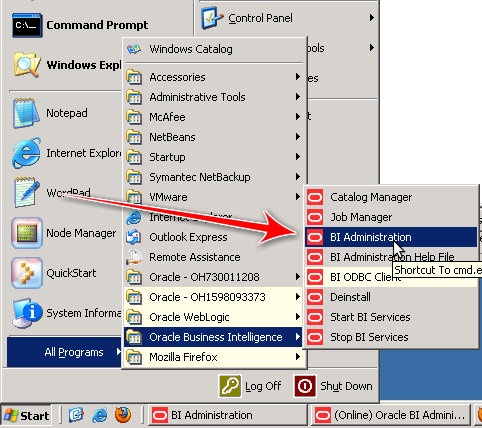
That will open up a shell window and eventuall the BI Administration tool will pop up.
Select File ==> Open ==> Online
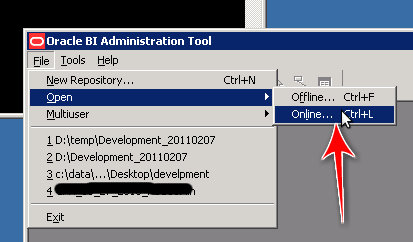
A challenge screen will then be opened:
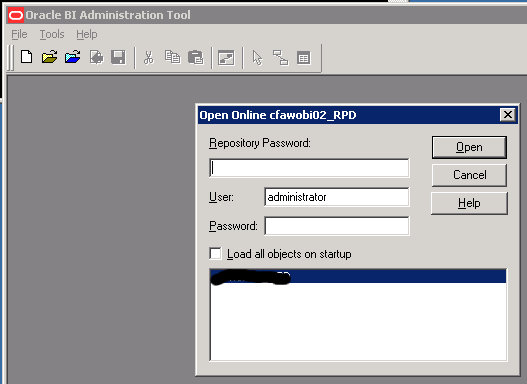
Enter the Repository Password, User and Password
You'll then be greeted with the metadata for the online repository.
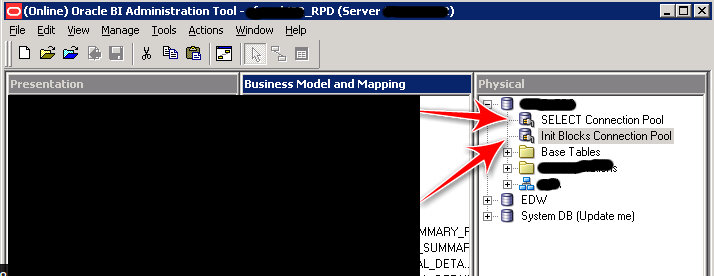
There are 3 layers to an OBIEE metadata repository:
- Presentation
- Business Model and Mapping (BMM)
- Physical
You only need to worry about the physical.
The arrows in the above picture point to the objects that you will need to modify, the Connection Pools.
Double click on the Connection Pool you need to update. You'll be asked if you would like to check it out.

Select Yes.
Now the important part. The Connection Pool properties box will open up. Make sure you are on the General tab and then locate the Password text field.
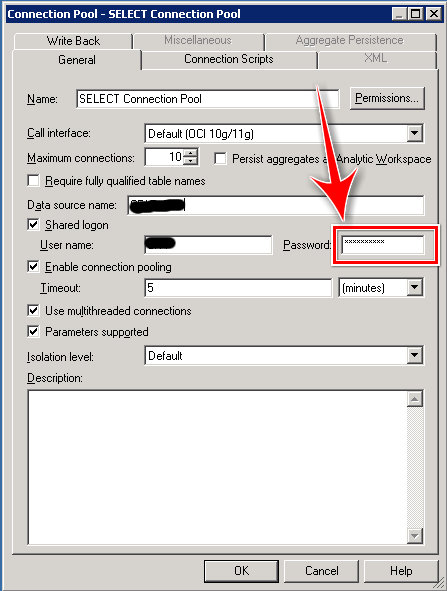
Enter the password for the specific user into the Password text field.
When you hit OK, you'll be prompted for the password again.
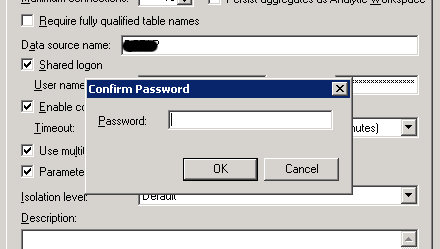
Enter it and hit OK.
Repeat this step for each of the Connection Pools in the environment. Each physical database has one or more Connection Pools, so you must update them all.
Now you must Check in your changes and then Save them.
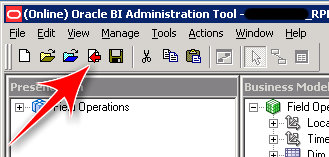
After hitting the Check in button and the changes have been, checked in, that button will become grayed out. When that happens, click on the Save button.
These changes will be immediately applied to the repository.
After logging into the production server that contains the client tools, go to Start ==> All Programs ==> Oracle Business Intelligence and select the BI Administration tool
That will open up a shell window and eventuall the BI Administration tool will pop up.
Select File ==> Open ==> Online
A challenge screen will then be opened:
Enter the Repository Password, User and Password
You'll then be greeted with the metadata for the online repository.
There are 3 layers to an OBIEE metadata repository:
- Presentation
- Business Model and Mapping (BMM)
- Physical
You only need to worry about the physical.
The arrows in the above picture point to the objects that you will need to modify, the Connection Pools.
Double click on the Connection Pool you need to update. You'll be asked if you would like to check it out.
Select Yes.
Now the important part. The Connection Pool properties box will open up. Make sure you are on the General tab and then locate the Password text field.
Enter the password for the specific user into the Password text field.
When you hit OK, you'll be prompted for the password again.
Enter it and hit OK.
Repeat this step for each of the Connection Pools in the environment. Each physical database has one or more Connection Pools, so you must update them all.
Now you must Check in your changes and then Save them.
After hitting the Check in button and the changes have been, checked in, that button will become grayed out. When that happens, click on the Save button.
These changes will be immediately applied to the repository.
Tuesday, May 17, 2011
The Zone
By Enrique Aviles
When was the last time you were in "the zone"? I'm talking about that special moment when you are able to construct a mental representation of a complex task with none of its parts missing. You've managed to take a large problem and break it apart into smaller pieces that you fully understand thus giving you a clearer picture of the original bigger problem. At this stage you are completely focused, ideas are flowing, and you feel confident what seemed like a daunting task is now under your control. This mental state is typically associated with programming or software development but it applies to pretty much any task that requires deep focus and concentration. Programmers in the movie The Social Network were known to be "wired in" when they were in the zone
For me, this is usually achieved when I'm alone at work or at home. The seating arrangement at work is great for collaboration since I share cubicles with three colleagues but makes it almost impossible for me to get in the zone.
Recently I had to optimize a large query that feeds a Crystal Report. Notice I said query, not queries, so all the data was gathered with a single query. This query was actually a UNION of several queries each joining tables, views, inline views, and a few IN clauses. It wasn't until I was able to enter the zone that I managed to make significant progress troubleshooting the monster query and develop a solution that made a significant impact.
What are some of the hurdles that prevent us from entering the zone? Are they limited to the office? Perhaps it is better to work from home, but is that even a plausible option? Emails, phone calls, instant messaging, impromptu meetings, people asking for help and casual conversations make it very difficult for someone working on a complex task to enter the zone. Working from home could aggravate the issue since the only means of communication are limited to phone calls, emails or instant messages. Nobody knows how busy you may be so interruptions might occur more frequently than if you were in the office.
How do you find the zone? As with everything else this could be a matter of personal preference. Some people (like me) prefer silence and virtually no external stimuli while others are content and strive in the midst of chaos. Regardless of what your style may be one thing is certain: it is almost impossible to achieve deep concentration if one is frequently interrupted. Unless you possess special mental abilities that allow you to context switch as quickly as a modern CPU, most everyone requires a special setting and the right conditions in order to enter the zone.
The average IT professional would be more productive and enjoy greater job satisfaction if he/she is able to enter the zone more often. We would be able to develop better designs, troubleshoot more efficiently, and devise smarter solutions. Entering the zone is a rewarding experience not only because it helps us solve complex problems but because it shows us the level of mental prowess we are able to attain.
When was the last time you were in "the zone"? I'm talking about that special moment when you are able to construct a mental representation of a complex task with none of its parts missing. You've managed to take a large problem and break it apart into smaller pieces that you fully understand thus giving you a clearer picture of the original bigger problem. At this stage you are completely focused, ideas are flowing, and you feel confident what seemed like a daunting task is now under your control. This mental state is typically associated with programming or software development but it applies to pretty much any task that requires deep focus and concentration. Programmers in the movie The Social Network were known to be "wired in" when they were in the zone
For me, this is usually achieved when I'm alone at work or at home. The seating arrangement at work is great for collaboration since I share cubicles with three colleagues but makes it almost impossible for me to get in the zone.
Recently I had to optimize a large query that feeds a Crystal Report. Notice I said query, not queries, so all the data was gathered with a single query. This query was actually a UNION of several queries each joining tables, views, inline views, and a few IN clauses. It wasn't until I was able to enter the zone that I managed to make significant progress troubleshooting the monster query and develop a solution that made a significant impact.
What are some of the hurdles that prevent us from entering the zone? Are they limited to the office? Perhaps it is better to work from home, but is that even a plausible option? Emails, phone calls, instant messaging, impromptu meetings, people asking for help and casual conversations make it very difficult for someone working on a complex task to enter the zone. Working from home could aggravate the issue since the only means of communication are limited to phone calls, emails or instant messages. Nobody knows how busy you may be so interruptions might occur more frequently than if you were in the office.
How do you find the zone? As with everything else this could be a matter of personal preference. Some people (like me) prefer silence and virtually no external stimuli while others are content and strive in the midst of chaos. Regardless of what your style may be one thing is certain: it is almost impossible to achieve deep concentration if one is frequently interrupted. Unless you possess special mental abilities that allow you to context switch as quickly as a modern CPU, most everyone requires a special setting and the right conditions in order to enter the zone.
The average IT professional would be more productive and enjoy greater job satisfaction if he/she is able to enter the zone more often. We would be able to develop better designs, troubleshoot more efficiently, and devise smarter solutions. Entering the zone is a rewarding experience not only because it helps us solve complex problems but because it shows us the level of mental prowess we are able to attain.
Subscribe to:
Posts (Atom)